

It’s 9:00 on a Tuesday in November. Eight people carry their coffees into the glass-walled boardroom of a soft drinks manufacturer. The radiator ticks. Someone’s laptop chimes with a calendar reminder for the meeting they’re already sitting in.
The agenda has eleven items. They will get through four.
Marta, the CFO, walks the room through last month’s numbers. Slide after slide. Heads nod on cue. Nobody asks a question because the deck went out at 11 the night before, and everyone already skimmed it. Twenty minutes, gone.
Then the new bottling line. Late again. It’s the third revised deadline this year. The CEO leans back, folds his arms, and asks the question he has been asking for months: “So who owns this?”
Silence. The last person who put their hand up for a late project is no longer in the room. Two people study their laptops. One looks at the ceiling. The head of operations eventually says, “It’s complicated,” and starts to explain. Eleven minutes later, nobody in the room is any clearer.
By item four, the discussion has sunk into a pricing issue that matters to exactly two of the eight people present. The others are quiet. Thumbs move under the table. A phone screen glows on someone’s knee. Outside the glass, the bottling line runs below them, filling and capping, filling and capping, while the people meant to be steering the company circle the same point for the fourth Tuesday in a row.
At 10:00 sharp, the CEO glances at the clock. “Good discussion. Let’s pick this up next week.” Chairs scrape. On the table, bottles of the company’s own soft drink sit untouched, going warm.
By the door hangs the strategy. Twelve priorities, printed on glossy paper, framed last January. Stop any one of these eight leaders in the corridor and ask what the company is really trying to win this quarter, and you’ll get eight different answers.
The executives are smart, experienced, and they care about the business more than they would ever say out loud. But every week they push as hard as they can, and every week the company’s strategic initiatives barely move.
This describes closely the situation in the boardroom of one of our clients. Over the year that followed, my colleagues at Unblock and I helped them adopt the following nine habits. None of them is revolutionary. But practiced together, they turned the team and their business around.
Habit 1: Act like a team, not a working group
Most leadership teams are not teams at all. They are a group of department heads who happen to share a calendar invite. Each person plays their own game, and the scores get totaled at the end.
That’s how teams work in golf. What the business needs is a football team, where the players are *inter*dependent and chasing success as a team.
Let the team define the shared outcomes it owns together, not just the sum of individual targets. When those are clear, the internal lobbying stops.
Habit 2: Create a strategy that focuses daily work
A strategy that lives in a frame on the wall is merely decoration. Most leadership teams either list twelve priorities or settle on one vague ambition.
Before the 1940s, nobody used the plural “priorities.” There can only be one thing that is most important. Write a Strategic Intent that's simple enough for anyone to read and understand what their #1 priority is. Then make your trade-offs explicit with Even-Over statements, like “speed even over cost.” If you don’t choose your trade-offs, the world around you will choose them for you.
Habit 3: Steer in short cycles
Detailed annual plans give a comforting illusion of control. Then reality arrives in February, and the plan quietly slides into a drawer. When things are complex, you can realistically see about a quarter ahead. So steer with 90-day Outcomes. Review them every week, refresh them every quarter.
Add a few Steering Metrics for navigation, leading indicators that tell you you’re on the right track. But keep them out of bonuses: the moment a metric becomes a target, it stops telling the truth.
Habit 4: Make decisions fast
In stuck teams, decisions float upward and get heavier on the way. “We wouldn’t want to bother the senior people with the small stuff.” So everything waits at the top.
Before your next big call, ask one question: Is this a hat, a haircut, or a tattoo? Most decisions are hats. You can put them on and take them off again. Make those decisions quickly.
Only a few decisions are like tattoos. The test is not “Is this the right decision?” It’s “is it good enough for now, safe enough to try?”
Habit 5: Build ownership instead of demanding it
You cannot order people to take ownership. Telling someone they are “empowered” changes nothing. Instead, set clear boundaries that free people to act: a waterline that defines acceptable risk, and explicit decision rights so their initiative is pre-approved. Then comes the hard part. When something wobbles, resist the urge to take control back. Ownership arrives on foot and leaves on horseback.
Habit 6: Develop habits for reflection and feedback
Google studied 200 of its teams. How people worked together mattered far more than who was on the team. The biggest driver was whether people felt safe to speak up.
Everyone wants to be part of a team that is psychologically safe and promotes learning, but it is easier said than done. The key is to train the team on new habits.
Run a short retrospective every 4-6 weeks and ask what to keep, stop, and start. Add a closing round where everyone shares one honest thing. Discomfort fades with repetition. Like going to the gym, the first few reps hurt, and then you build the muscle.
Habit 7: Adopt a designed meeting rhythm
Meetings are like mushrooms. They keep growing back unless you change the conditions. Most organizations respond to a problem by adding a meeting, and soon the week is a traffic jam. Instead, carefully design your Operating Rhythm so that each meeting has a clear purpose and cadence, and they interlock: a weekly meeting to unblock the work, a monthly retrospective, and a quarterly strategy session. Put status updates in a place everyone can see, so the reporting meeting can finally die. Keep your 1:1s for coaching and relationship, not information transfer.
Habit 8: Simplify relentlessly
Speed is not about adding force. It’s about removing weight. Still, most organizations suffer from organizational obesity: approvals, handovers, and reports nobody reads. Each rule was usually added after a single bad incident and never removed. We are great at filling the kitchen drawer and terrible at emptying it.
So ask your team every week: what is getting in the way of doing your best work? Then remove it. When in doubt, throw it out. You can always add it back later.
Habit 9: Redefine the leader’s role
Here’s the shift underneath all the others. Stop being a ‘traffic controller’ who knows every detail and gives orders. Instead, become a ‘road designer’ who builds the environment where good results happen on their own, even when you are not in the room. Clear direction, sensible guardrails, room to move.
And model it, every single day. If you want a calmer, faster team that takes ownership, the change starts with how you show up in that Tuesday meeting. Ultimately, people pay far more attention to your feet than your lips.
Where to start
Don’t try to install all nine at once. That’s just a new kind of overload. Look at the list and find the habit that hurts the most right now. Pick that one. Run a small experiment for 90 days and see what you learn.
The team in that boardroom didn’t change overnight. They changed one habit at a time. A year later, the meetings were shorter, the decisions were faster, and the needle finally moved.
What I’ve been up to
An executive team from Henry Schein invited me to their offsite to teach them about the wonderful world of Formula teams.
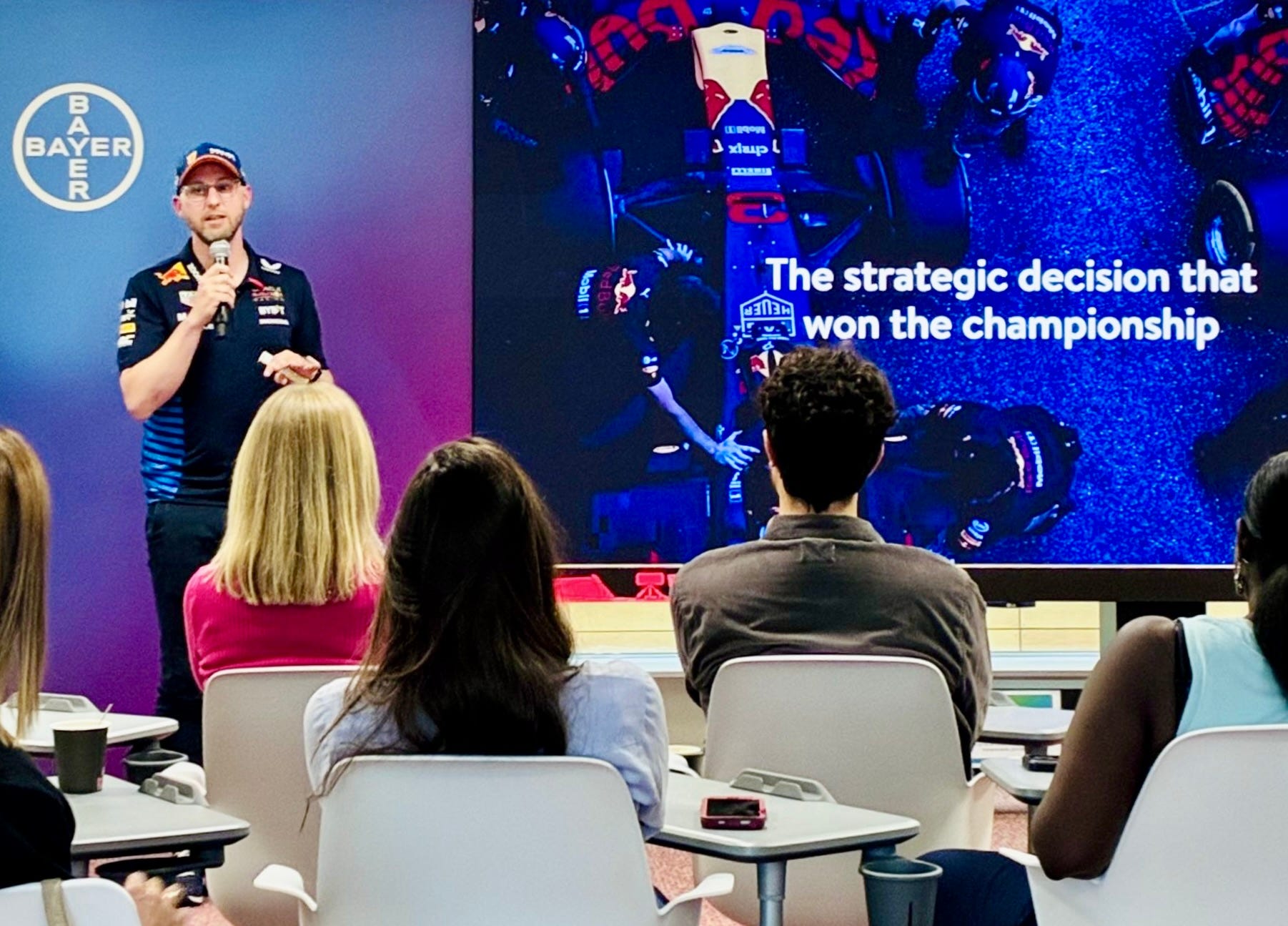
My colleague Koen and I facilitated a session at Bayer in Barcelona, where teams are in the lead rather than managers.
I was announced as keynote speaker at the Regional Scrum Gathering Brussels, October 8-9. Will I see you there?
That’s it. I hope you’ll use this to your advantage. To dive deeper, grab your copy of one of my books Formula X or Unblock. Or book me as a speaker at your next event. To get in touch, simply hit ‘reply’ or comment. I read every message.
The 'hat, haircut, or tattoo' test is such a simple way to name something I've seen happen over and over — small decisions getting treated with the same caution as permanent ones, just because no one wants to be wrong. I imagine most teams could move a lot faster if they were honest about how many of their 'big' decisions are actually just hats.