Five PowerPoints a day
Why 94% of companies see little bottom-line impact from AI, and what the other 6% do differently.

Someone who used to make one PowerPoint a day can now make five.
That’s what a typical AI success story sounds like today.
Is that better? Five times the slides. Five times the reading. Five times the meetings to discuss them.
This is what AI deployments look like in most companies: optimizing within the silos. Finance automates its reports. HR automates its job ads. Marketing produces more content.
And the customer? Still waiting.
Small efficiency gains in every department, but no real change where it counts.
I’m not surprised to read that only 6% of companies using AI see a significant impact on the bottom line, according to McKinsey’s State of AI survey.
Those 6% aim for growth and innovation rather than efficiency. And they have fundamentally redesigned how they deliver value to the customer.
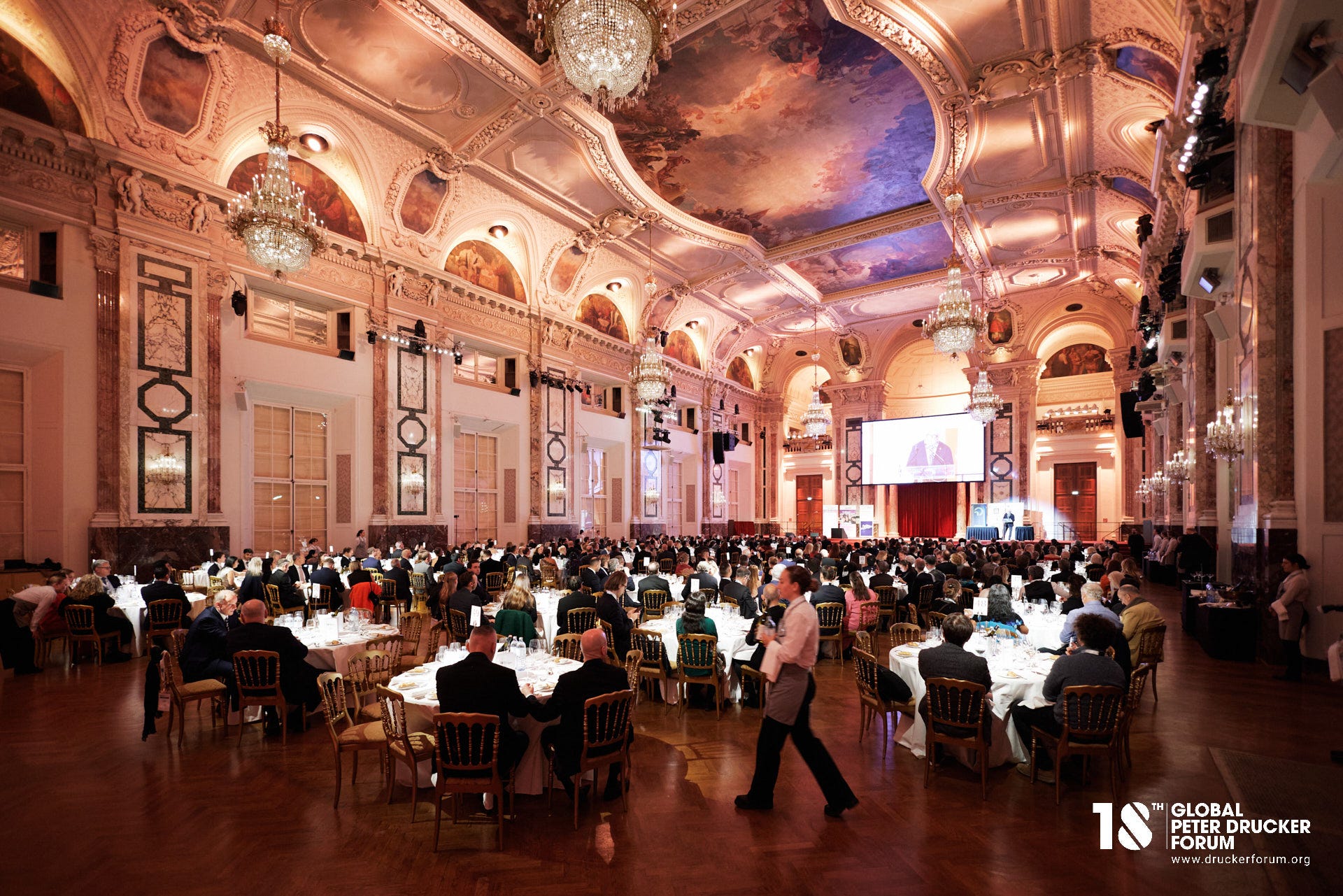
Why do the other 94% fall short? Rarely because of the technology. Mostly because the organization gets in the way. At the Global Peter Drucker Forum in Vienna, I found some surprisingly concrete answers on how to build an organization that makes the most of AI.
A spotlight rather than a scalpel
Take GE Appliances, a Haier company. It’s organized into hundreds of self-organizing teams with ‘zero distance’ to the customer.
Its CEO, Kevin Nolan, was crystal clear. They don’t use AI for efficiency. The only thing that counts is customer satisfaction.
With AI, they can suddenly combine data streams from across departments, products, customer interactions and the appliances themselves into one view. And what did they find? Hundreds of problems they never knew existed.
For them, AI works like a spotlight. Switch it on, and every crack in the customer experience lights up.
If GE Appliances had a traditional management hierarchy, it would be difficult to act on the newly revealed problems. But since their teams aren’t locked into a fixed structure, they can quickly move people and talent to the problems the spotlight reveals.
Unlike the CEOs who fire people for ‘AI efficiency gains’, Nolan said he actually needs more people to fix those problems, especially young people, because they’re really good with these tools.
The panel’s conclusion was clear: AI doesn’t need fewer people; it needs better leadership. Leaders who raise their ambition from short-term cost-cutting to creating better outcomes for customers and society.
IKEA shows what that looks like. When AI bots took over routine customer questions, IKEA didn’t let its call center staff go. It retrained around 8,500 of them as remote interior design advisers.
Too big, too old, too regulated?
You might think: that would never work for us. We’re too big. Too old. Too regulated.
Meet Bayer. A 160-year-old company with around 90,000 people, in one of the most regulated industries on the planet.
Over the last two years, Bayer removed roughly 70% of its managers, around 16,000 of them. There’s now about one manager for every 30 employees.
As Bayer’s CEO Bill Anderson pointed out, you can’t command and control 30 people. And that’s precisely the point.
Job titles and hierarchies are gone. In their place: skill-based communities and fluid networks of mission-based teams. Bayer calls it Dynamic Shared Ownership.
The numbers are striking:
About 95% of decisions sit with the people doing the work.
Around 6,000 teams ask every 90 days whether they should continue or reconfigure.
Resources move freely to the most important work. The org chart still exists, but nobody uses it day to day.
And that’s exactly the kind of organization where the AI spotlight pays off. When AI reveals a problem, a team can form around it within the next 90-day cycle.
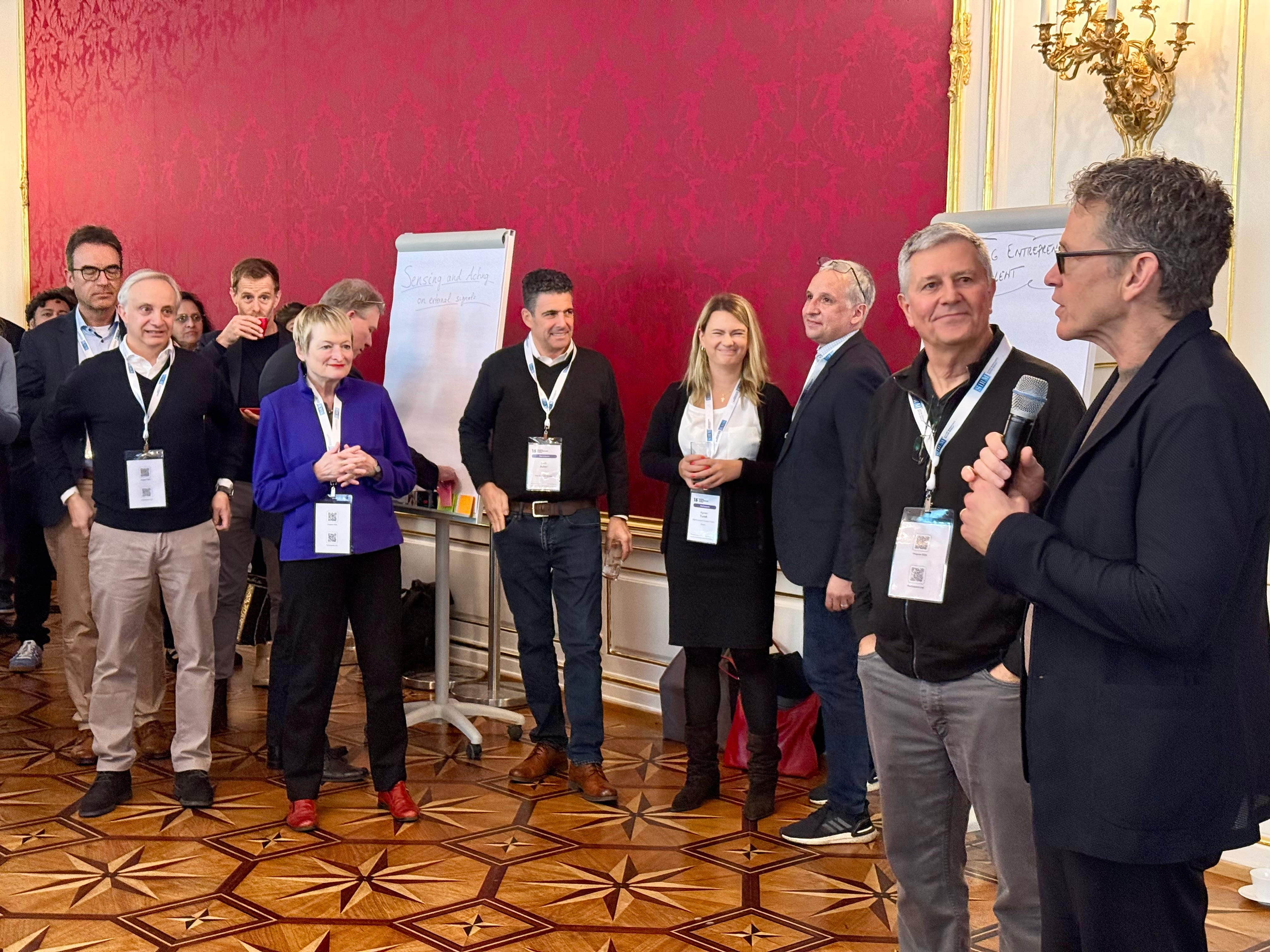
At the Forum, a group of Bayer employees ran a workshop in which we explored that very question: what kind of organization is best suited to make the most of AI? Our conclusion: small, autonomous teams with a clear customer purpose, using AI across silos.
If a 160-year-old life sciences giant can do this, what’s your excuse?
Everyone is a maker
Listening to both CEOs, I noticed what they have in common. Both have a deeply ‘people-positive’ mindset.
They see people as much more than ‘semi-programmable robots’. They believe people are incredibly powerful and we consistently underestimate their capabilities.
In the age of AI, you can’t afford to hire amazing talent and turn them into average performers within months.
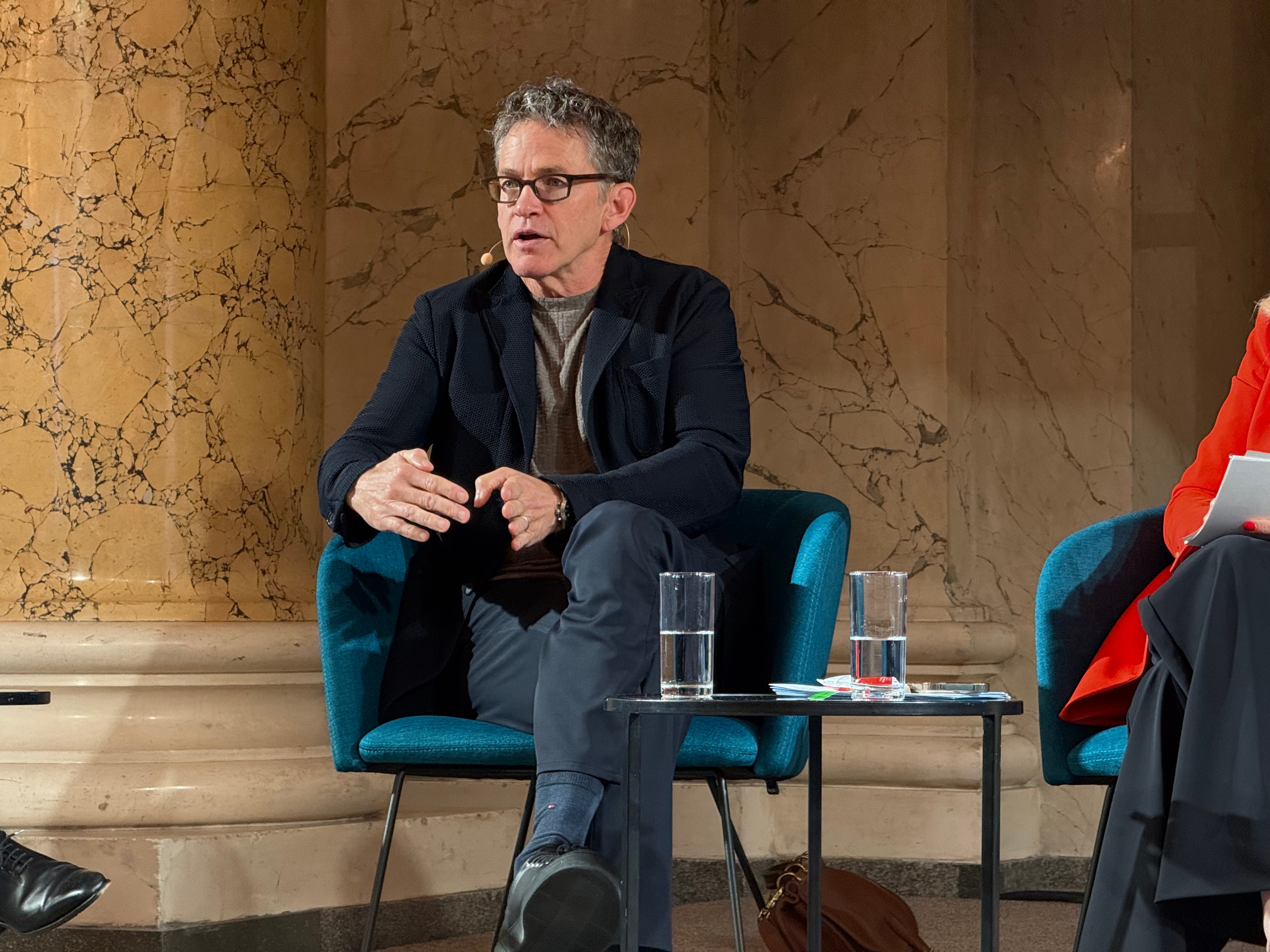
As Nolan put it, everyone is a maker. We cook, we fix, we make things. But at work, we rarely get to use that skill. AI changes that. Suddenly anyone can build a tool, a prototype, even a product. Leaders who tap into that builder instinct unlock a huge amount of human potential. Look what happens at GE Appliances, where people can use any AI tool they like:
“People in HR are building their own software. People in our factories are creating tools to solve problems on the manufacturing floor. People across our business are doing things I never would’ve imagined.”
The people closest to the work and the customer now have the tools to solve problems, explore ideas and even create something entirely new. It starts with trusting people to know what needs to be done, and giving them the freedom to go do it.
Leaders become designers
That doesn’t mean leaders become less important. Quite the opposite. Anderson explained that new leaders at Bayer first have to get out of the decision-making business. Now, they spend most of their time as ‘architects’, or, as I’d call it, organization designers.
Their job is answering questions like: how do we run this department of hundreds of people without a traditional hierarchy?
It may sound chaotic, but it is not. Organizing principles are what create discipline and keep everything together. Or, as Anderson put it: “It’s the mechanics, stupid.”
Where to start
You don’t need to initiate a full organizational transformation to get the benefits. Here are a few moves you can make right away.
Go first. Get hands-on AI training. Start building things. A simple test for your next leadership meeting: what did each of us do with AI ourselves this week? If the answer is nothing, start there.
Create strategic clarity. When teams and resources move freely, clarity about where you’re heading is the glue that holds everything together.
Spread the bet. Allow many different paths at the same time. Nobody knows yet which ones will work in your context.
Find the person with taste. Look for the Steve Jobs-like person in your company and give them a small team.
Go bottleneck by bottleneck. Don’t design an AI-first operating model on paper and transform toward it. Instead, ask where your customer waits the longest. Look for the biggest bottleneck between departments, then ask which AI experiment could remove it in 90 days.
Same AI, different results
History has a lesson here. When electricity reached factories around 1900, most owners simply swapped their steam engine for one big electric motor. Same layout, same way of working. For decades, productivity barely moved. The big gains only came in the 1920s, when factories were redesigned around the new technology.
AI is the new motor. Your organization is the factory floor. AI won’t redesign it for you. It will only expose where it’s broken.
Your competitors have access to the same AI as you. Your organization will set you apart.
So by all means, make five PowerPoints a day. Just don’t call it transformation.
In other news
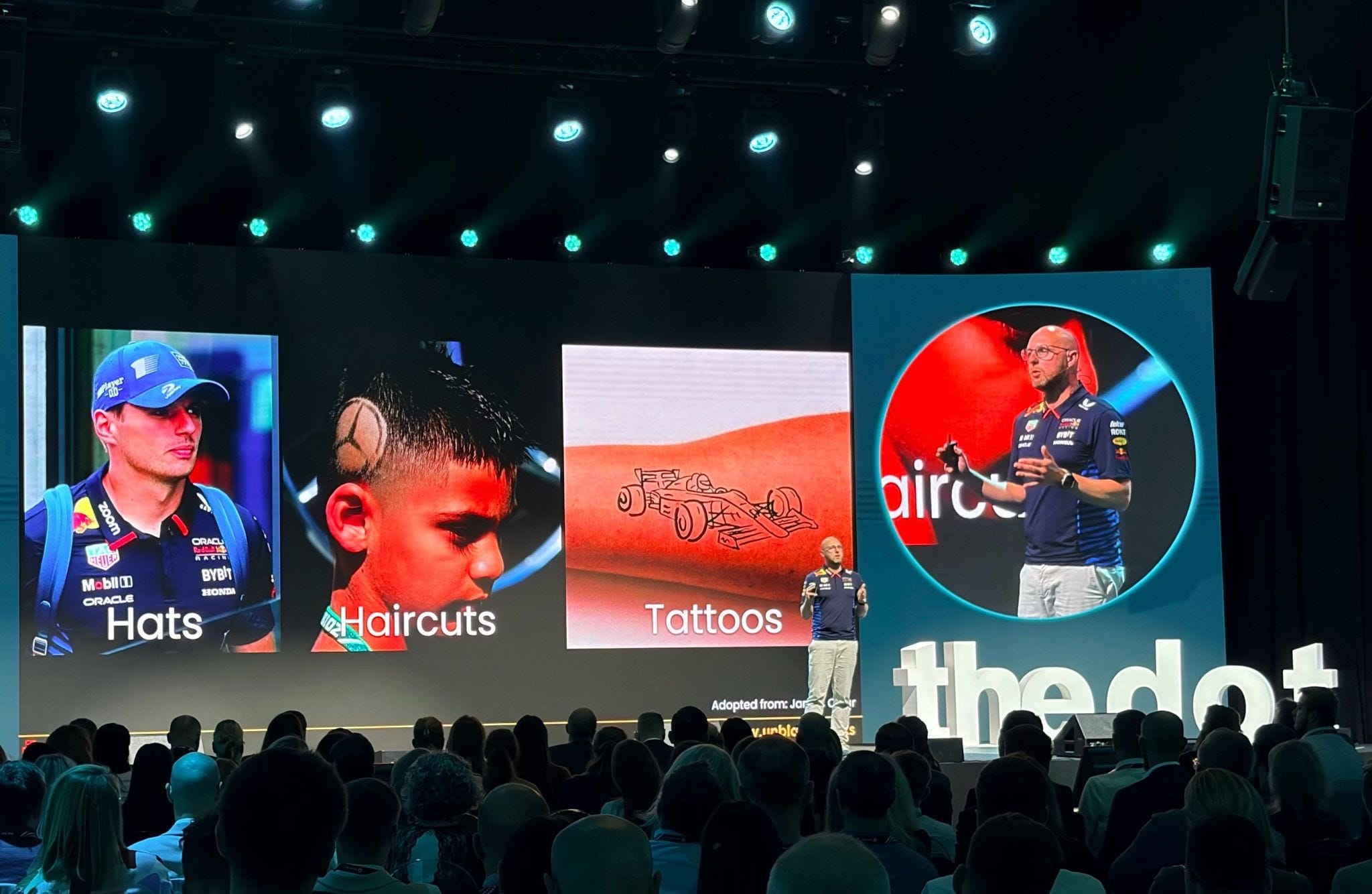
Took the train to Vienna for the Drucker Forum.
Met one of my strategy heroes, Roger Martin.
Spoke at a Swiss Re leadership conference in Bratislava.
Tomorrow: on stage at Lead27 in Zürich.
Next week: my first solo Hyrox.
That’s it for this edition! To dive deeper, grab your copy of one of my books Formula X or Unblock. To get in touch, simply comment or reply. I read every message.

Discussion about this post